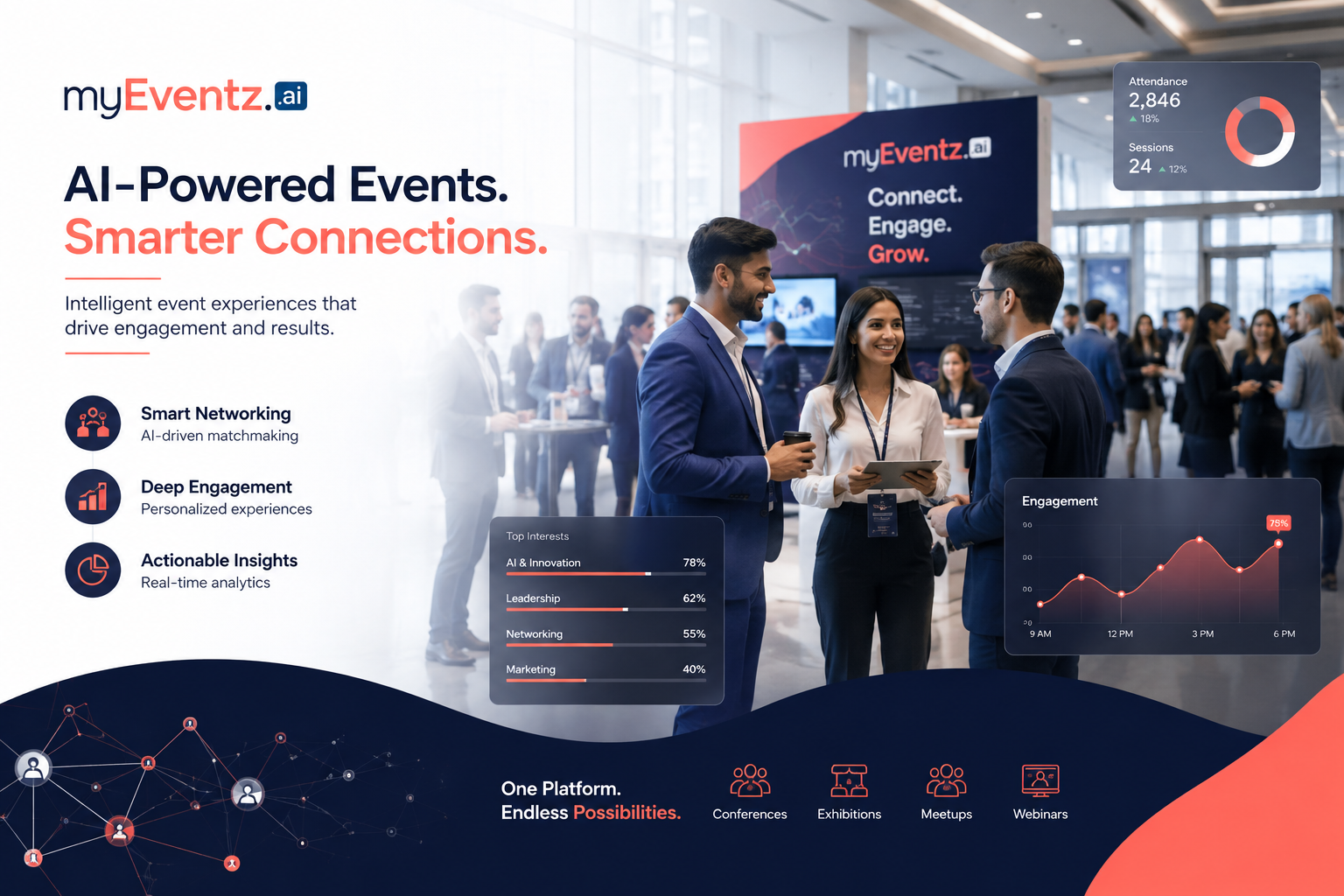
Events are becoming one of the most trusted ways for brands to build meaningful connections. As digital advertising becomes increasingly crowded with automated content, misinformation, and endless brand messages, audiences are placing greater value on experiences that feel genuine.
This shift is changing how businesses approach event marketing. An AI event app can help organizers combine the authenticity of in-person experiences with the intelligence, personalization, and data capabilities of modern technology.
From AI-powered attendee matching and event networking to lead capture, scheduling, and event ROI analytics, technology is making events more measurable and more connected across the entire customer journey.
Why In-Person Events Are Becoming More Valuable
Marketers are operating in an increasingly uncertain digital environment. Brands have to consider where advertisements appear, how audiences respond to them, and whether automated platforms can deliver meaningful engagement.
In-person events offer something digital advertising cannot easily replicate: direct human interaction.
Attendees can speak with representatives, ask questions, experience products, and build relationships in real time. This creates a level of credibility and trust that is difficult to achieve through a digital advertisement alone.
That is why events are increasingly being treated as strategic marketing channels rather than one-off brand activations.
An AI event management platform can strengthen this approach by helping organizers manage the data and interactions generated before, during, and after an event.
AI Event Apps Are Changing Event Networking
One of the biggest challenges at conferences, exhibitions, and corporate events is helping attendees find the right people.
Traditional event networking often depends on attendees browsing profiles, exchanging business cards, or simply approaching people at random. That creates a lot of friction and does not guarantee meaningful connections.
An AI event networking app can use attendee profiles, interests, professional goals, and behavioral information to recommend relevant connections.
This is where AI attendee matching and event matchmaking software become valuable.
Instead of asking attendees to figure out who they should meet, an AI-powered event platform can help identify relevant people and opportunities based on the information available.
For organizers, this can increase networking activity and create a more personalized attendee experience.
Platforms such as Swapcard and Grip demonstrate how AI-powered networking and matchmaking are becoming part of modern event technology.
Events Are Becoming Part of a Larger Marketing Ecosystem
Events no longer exist in isolation.
A successful event can generate content, social conversations, partnerships, sales opportunities, customer insights, and follow-up campaigns. The event itself becomes one part of a much larger marketing ecosystem.
This is where an event intelligence platform can play an important role.
Rather than treating event data as something that disappears once the event ends, organizers can connect attendee interactions, networking activity, exhibitor engagement, and post-event behavior to create a more complete picture of the event.
An AI event app can support this process by connecting different stages of the attendee journey and turning event interactions into usable data.
Measuring Event ROI Beyond Attendance
Attendance has traditionally been one of the easiest metrics for event organizers to report.
But attendance alone does not tell you whether an event actually generated business value.
Modern event teams need to understand metrics such as:
- Attendee engagement
- Meeting and networking activity
- Exhibitor lead quality
- Lead capture
- Brand recall
- Pipeline influenced
- Customer engagement
- Post-event activity
- Sales conversions
An event ROI analytics platform can help organizations move beyond basic footfall and attendance metrics.
The objective is not simply to know how many people attended. It is to understand what those people did, which interactions mattered, and what business outcomes followed.
This makes events easier to evaluate alongside other marketing channels. Platforms such as Cvent have also expanded event technology beyond registration into engagement, data, and event management.
From Event Lead Capture to Follow-Up
For exhibitors and sponsors, generating qualified leads is one of the most important reasons to participate in an event.
Yet collecting a large number of contacts does not necessarily mean an event generated valuable leads.
An exhibitor lead capture app can help teams collect and organize information from conversations and interactions. AI can then be used to enrich profiles, identify relevant prospects, and support faster follow-up.
This is particularly important because the value of an event often depends on what happens after attendees leave.
If a promising conversation is never followed up, the opportunity can disappear.
Connecting event interactions with CRM systems and follow-up workflows allows organizations to continue the relationship beyond the physical event.
Modern event platforms such as Popl and momencio are also focused on event lead capture and lead intelligence, highlighting the growing importance of turning event interactions into actionable sales data.
Digital and Physical Experiences Should Work Together
The future of events is not about choosing between digital and physical experiences.
Both serve different purposes.
Digital channels provide scale, convenience, and continuous communication. Physical events create deeper interaction, trust, and emotional engagement.
An AI event app can connect these experiences.
Before an event, AI can help attendees discover relevant sessions, people, and opportunities.
During the event, it can support networking, scheduling, navigation, and personalized recommendations.
After the event, event data can be used to support follow-up, content discovery, and continued engagement.
This creates a connected experience rather than treating the event as a single isolated moment.
Personalization Is Becoming Essential for Event Engagement
Not every attendee has the same goals.
A sponsor may want qualified leads. An executive may want high-value meetings. A first-time attendee may need help navigating the event. Another attendee may primarily want educational sessions.
A generic event experience cannot effectively address all of these needs.
AI-powered personalization allows event platforms to adapt experiences based on attendee profiles and behavior.
An AI event app can recommend sessions, networking opportunities, exhibitors, and relevant content instead of presenting every attendee with the same experience.
The result is a more relevant event journey and potentially higher engagement.
Why Human Connection Still Matters in an AI-Driven World
The growth of AI does not make human interaction less important.
In many ways, it makes genuine human experiences more valuable.
As audiences encounter more automated content, algorithmic recommendations, and synthetic interactions online, face-to-face conversations provide something different.
Events give people the opportunity to ask questions, build trust, read reactions, and form relationships in real time.
AI should not replace that experience.
It should make the experience easier to navigate, more personalized, and more measurable.
That is the real opportunity for an AI event app.
The Future of Events Is Intelligent, Connected, and Human
Events are moving beyond simple registration and scheduling tools.
The next generation of event technology is focused on connecting attendee matchmaking, networking, exhibitor lead capture, event analytics, personalization, and post-event engagement within a single intelligent ecosystem.
An AI event management platform can help organizers understand the entire event journey rather than viewing individual interactions in isolation.
This is the direction myEventz.ai is built around: connecting attendee matchmaking, exhibitor lead capture, and organizer ROI and analytics through an AI-powered event intelligence layer.
The goal is not to make events less human.
It is to use AI to remove friction so people can spend more time having meaningful conversations and creating valuable connections.
As brands continue looking for more authentic ways to engage audiences, the combination of AI event apps and real-world experiences will become increasingly important.
The future of event marketing is not purely digital or purely physical. It is a connected experience where technology handles the complexity and people create the value.
Ready to make your events smarter?
See how myEventz.ai can help you connect attendees, capture leads, personalize experiences, and measure event ROI with AI-powered event intelligence.
Explore myEventz.ai →